How AVA gives South African care homes time back. Every form matters. But every minute spent searching for files, rewriting notes and preparing handovers is a minute a carer is not spending with a resident. EzeHealth and AVA, the AI nurse assistant, are changing that equation.
The paperwork problem nobody working in care needs explained
It is 18:45. The day shift is almost over.
A resident needs assistance. Another family is asking for an update. Medication must be checked. The night team is arriving. And somewhere at the nurse station there is still a pile of documentation that has to be completed before handover.
A blood pressure reading is written on one page. Fluid intake is recorded somewhere else. A carer remembers something important about a resident's mobility and tells the nurse verbally. A wound note needs updating. An incident form still requires a signature. Then comes the handover.
This is the daily reality of residential care: the same people we employ to care for residents are also expected to document almost everything that happens to those residents.
The documentation is necessary. The problem is the way it is traditionally done.
South African care homes cannot simply stop documenting
Care homes operate in a regulated environment, and good record keeping is part of good care.
South Africa's national norms and standards for residential facilities specifically address nursing-care administration, maintaining registers and individual care plans. They call for a personal record for each older person, an assessment document following admission, ongoing review of that assessment, updated care plans and relevant records and documentation.
Registered residential facilities may also be monitored. The Older Persons Act 13 of 2006 gives authorised officials powers that include requesting books or documents relating to the facility for inspection.
So the answer is not less documentation. The answer is better documentation. Because compliance should support good care, not compete with it.
Where care time disappears in a frail care or dementia care facility
The problem with paper-based care home management is rarely one spectacular failure. It is hundreds of small administrative tasks repeated every day.
1. Writing the same information more than once
A carer records something during a round. The information is later transferred to another sheet. Then it is mentioned during handover. Then the nurse may need to capture it again in an incident report, care plan or progress note.
The resident has not received four separate episodes of care. But staff may have documented the same event four different ways. That is administrative duplication.
2. Documentation gets postponed until the end of the shift
Care naturally takes priority. When a resident calls, staff respond. The form can wait.
The difficulty is that several hours later, a caregiver may have to reconstruct exactly what happened, when it happened and what was observed. Digital bedside documentation changes the workflow from:
Care → remember → return to office → find form → write
to:
Care → record immediately → done.
That is a fundamental operational improvement.
3. Finding information becomes work in itself
Paper is very good at storing information. It is not particularly good at finding it again.
A manager asking "When did Mrs Botha's appetite start declining?" may trigger a manual investigation through progress notes, fluid charts, weight records and shift reports. The information may all exist. The problem is that somebody has to find it, read it and connect it.
This is where AI becomes much more valuable than simply digitising a form.
Going paperless is not enough
A PDF on a computer is technically digital. A spreadsheet is digital. A photograph of a completed form is digital. But none of those automatically creates an intelligent care system.
The real opportunity is to convert daily care activity into structured resident data. That is what happens inside EzeHealth.
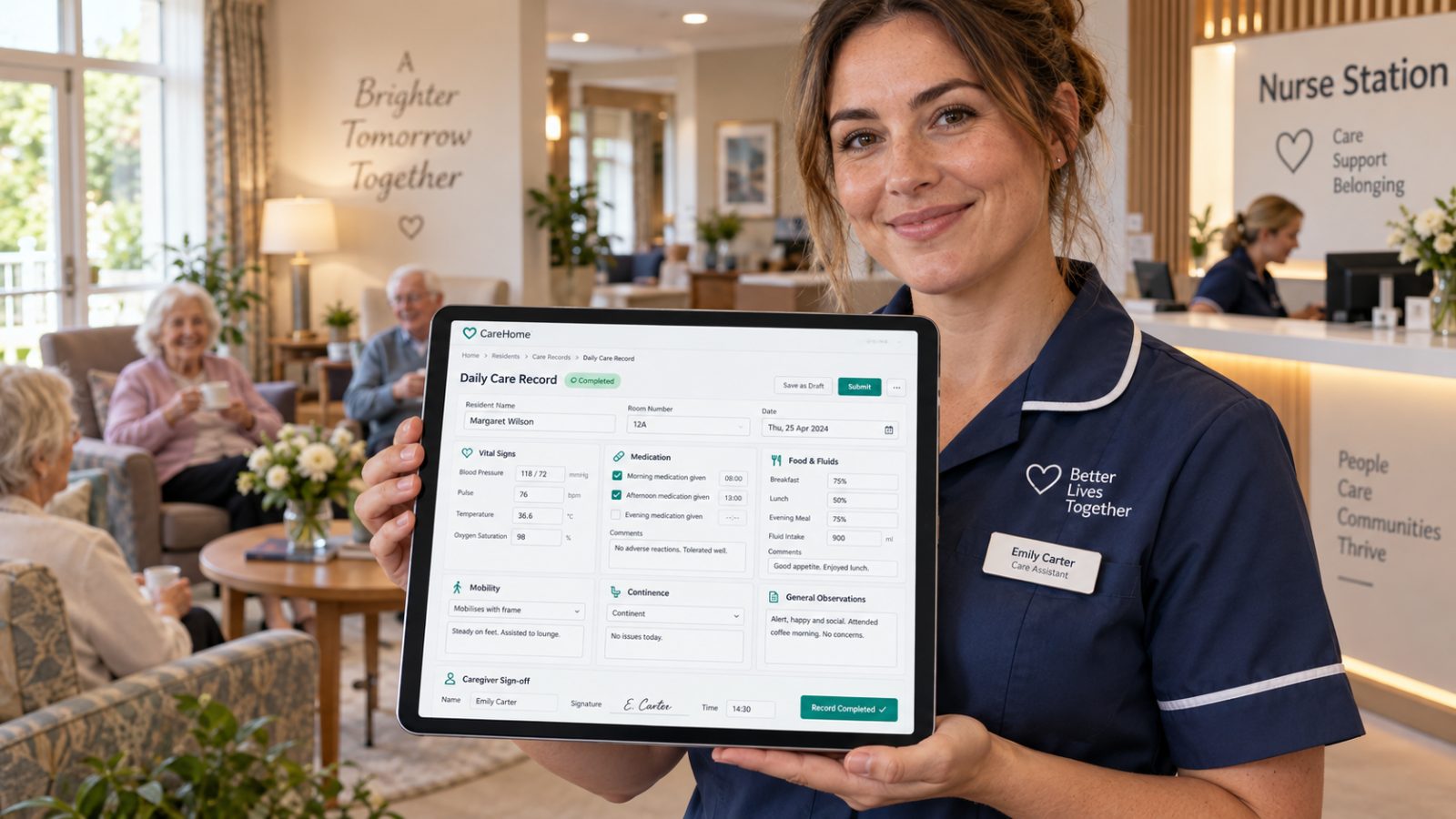
Carers submit structured bedside information through twelve clinical forms: vitals, medication, hygiene, incontinence care, incidents and care observations. Entries are timestamped and attributable to the staff member who captured them. The platform then structures that information into the resident record, where all 21 modules can use it.
And that structured information is what gives AVA her intelligence.
Meet AVA: the intelligence sitting behind the documentation
AVA is not there to replace the nurse. She is there to make the information captured by the care team useful.
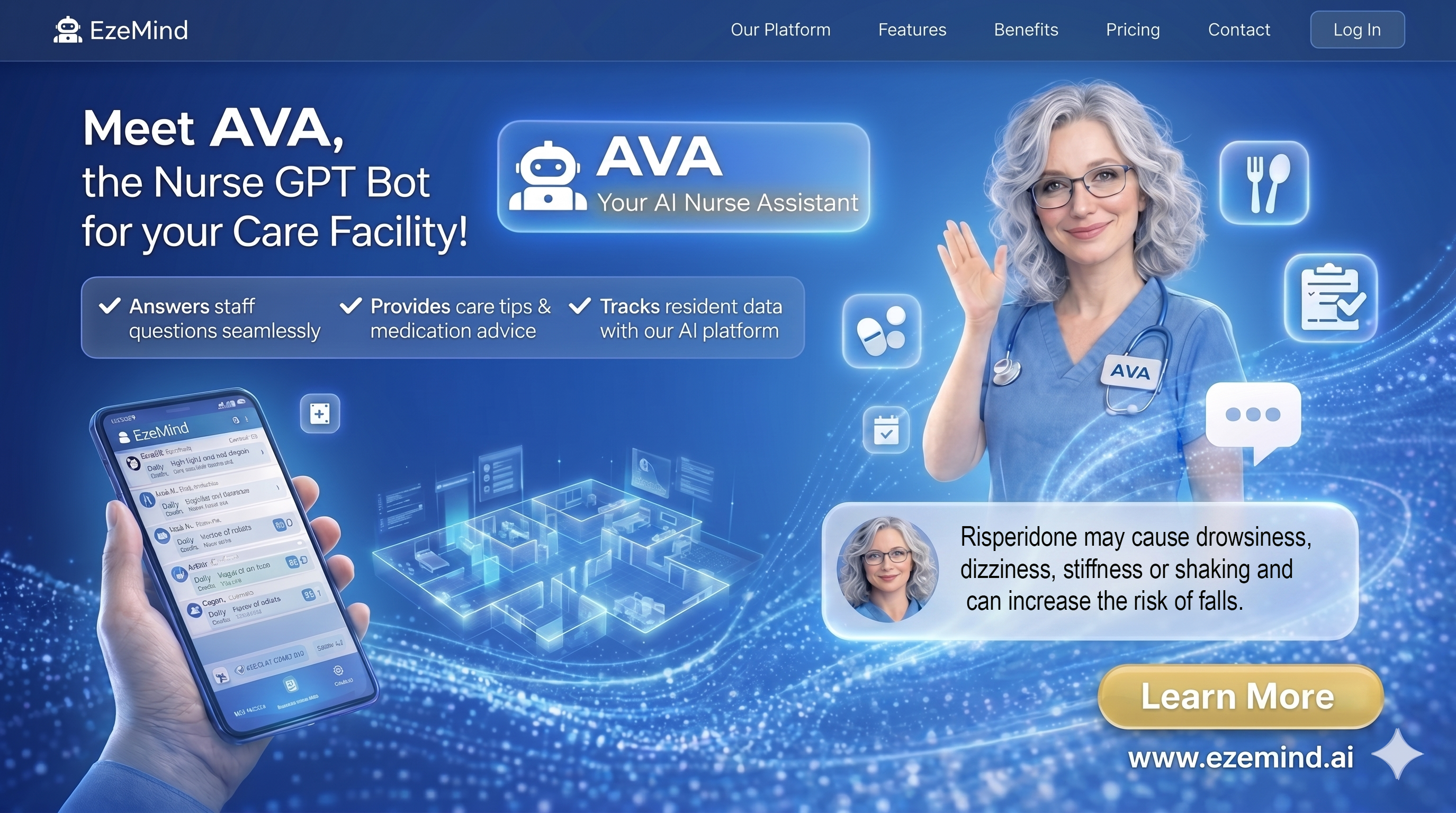
EzeHealth is the platform. EzeMind AI provides the intelligence underneath it. AVA is the AI nurse assistant your team talks to.
Instead of opening files and searching through individual records, authorised staff can ask ordinary questions:
- "Which residents had abnormal vitals today?"
- "Who did not finish breakfast this morning?"
- "Summarise the night shift."
- "Gee vir my mevrou Botha se nuutste vitals."
AVA works across the facility's structured records and returns the relevant information in seconds. She answers in both English and Afrikaans, and produces care and shift summaries from the home's own data.
That changes documentation from something staff merely store into something the care team can actively use.
The difference is what happens after the form is completed
Consider a traditional fluid-intake chart. Staff complete it diligently. At the end of the day, the information exists. But somebody still has to notice that a resident's intake has been trending downward.
With structured digital records, that same information becomes part of a wider clinical picture. AVA's three-tier clinical watchdog monitors for low fluid intake, abnormal vitals, missed hygiene care and medication compliance, with alerts recorded in the system and human review retained in the workflow.
So the form stops being the end of the process. It becomes the beginning of the intelligence.
Imagine the same shift again, with EzeHealth
It is 18:45. The day shift is almost finished. But this time, the day's care has already been captured while it happened.
- Vitals were recorded on the tablet.
- Meals and fluid intake are already against the resident record.
- Medication administration is documented on the digital MAR chart.
- Care observations have timestamps.
- Incidents are linked to the correct resident.
The incoming nurse does not have to reconstruct the day from different folders. AVA summarises the shift. The nurse reviews the information. The human remains responsible. But the administrative machinery has already done much of the organising.
That is the objective: not less accountability, less administrative friction.
Better information also means better conversations with families
Families rarely ask for a form. They ask: "How is Mom doing?"
On paper, answering that properly can mean collecting information from several staff members and several documents. A structured resident record brings together meals, vitals, incidents, activities, medication information and care observations.
AVA summarises resident information for handovers, GP consultations and family discussions. That allows the conversation to move from "I think she has been doing quite well" to "Here is what has actually been documented over the last seven days."
That is better governance. It is also better family communication.
And then there is POPIA
Care homes do not only hold names and telephone numbers. They hold medical conditions, medication information, diagnoses, incidents, photographs, family information and other highly sensitive resident data.
Under the Protection of Personal Information Act 4 of 2013, health information falls within special personal information, which deserves particular protection.
A paper folder is therefore not automatically the "safe" option simply because it is familiar. Digital transformation must be implemented properly, with access controls, accountability, security and appropriate data governance.
In EzeHealth, each facility operates in its own database environment, resident data is hosted in South Africa, AVA's interactions are logged and clinical decisions remain subject to human sign-off. Read more on our POPIA compliance page.
The objective is not technology for technology's sake. It is better controlled information.
AVA does not take care away from people. She gives people more time to care.
This may ultimately be the most important point. AI in a care home should never be measured simply by how clever the AI appears. It should be measured by what changes on the floor.
- Can the nurse find information faster?
- Can the caregiver document closer to the point of care?
- Can management see what happened overnight without searching through files?
- Can a shift handover be prepared from actual recorded events?
- Can clinical patterns become easier to identify?
- Can an inspection trail be produced without days of preparation?
And most importantly: can we return more staff time to the resident?
That is why AVA exists. Not to create a futuristic care home in which machines replace human relationships. Quite the opposite. AVA uses technology to protect the part of care that technology can never replace: human attention.
From paperwork to care intelligence
South African care facilities will always need documentation. Residents deserve it. Families expect it. Nurses rely on it. Management needs it. Regulators require it.
But there is no strategic advantage in making highly trained people spend unnecessary time searching, rewriting, filing and summarising information that technology can organise automatically.
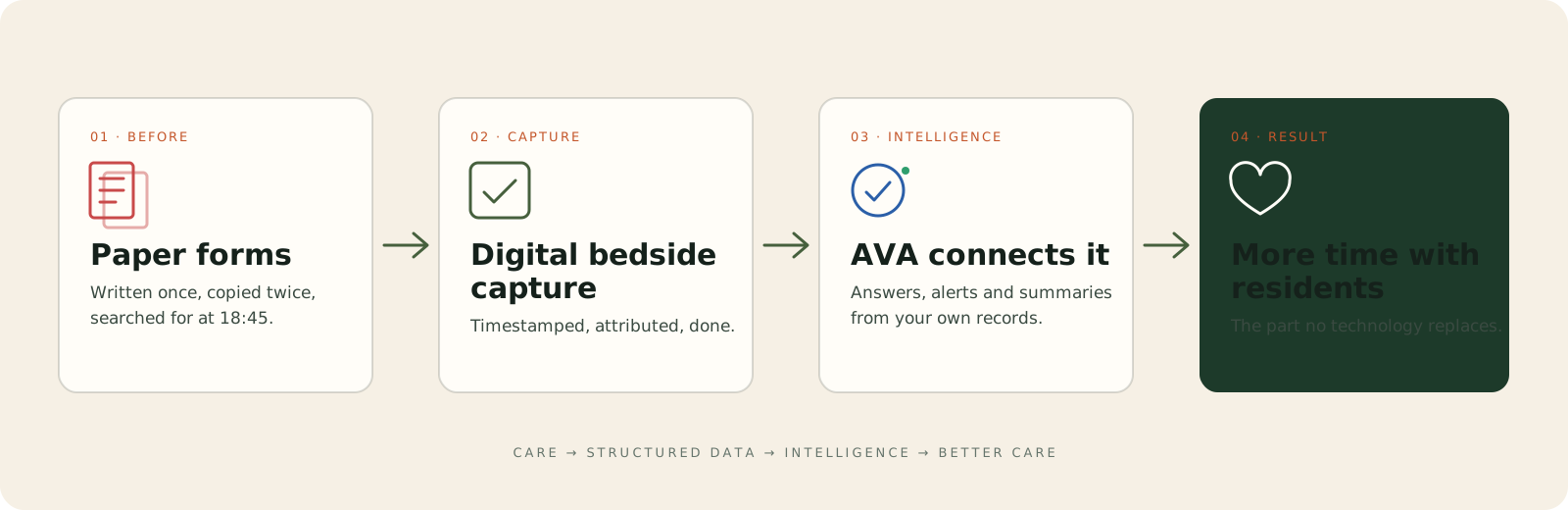
The next generation of care home management software is therefore not simply paper → computer. It is:
Care → structured data → intelligence → better care.
And that is where EzeHealth and AVA fit. See per-resident pricing, or book a 15-minute demonstration of AVA working in a real care environment.
Frequently asked questions
Can a South African care home reduce paperwork without breaking the regulations?
Yes. The regulations under the Older Persons Act require records, assessments and care plans to exist and be kept up to date. They do not require paper. Structured digital records that are timestamped, attributable and available for inspection meet the requirement while removing duplication.
What is an AI nurse assistant?
An AI nurse assistant is software that answers clinical and operational questions from a care home's own records in plain language. AVA, built into EzeHealth, answers in English and Afrikaans, monitors vitals, intake and medication compliance, and produces shift and resident summaries. Nurses remain responsible for every clinical decision.
Is resident data safe in a digital care management system?
It can be safer than paper when implemented properly. EzeHealth hosts each facility's data in its own database in South Africa, logs every AVA interaction, and keeps human sign-off in the workflow, in line with POPIA's treatment of health information as special personal information.
The AI nurse that never sleeps
AVA works alongside your care team 24 hours a day, turning the information your staff already capture into a living, searchable picture of your residents and your facility.
Built in South Africa. Built inside real care. Built to give care teams their time back.
EzeHealth by EzeMind AI · George, Western Cape · 044 333 0646 · info@ezehealth.co.za