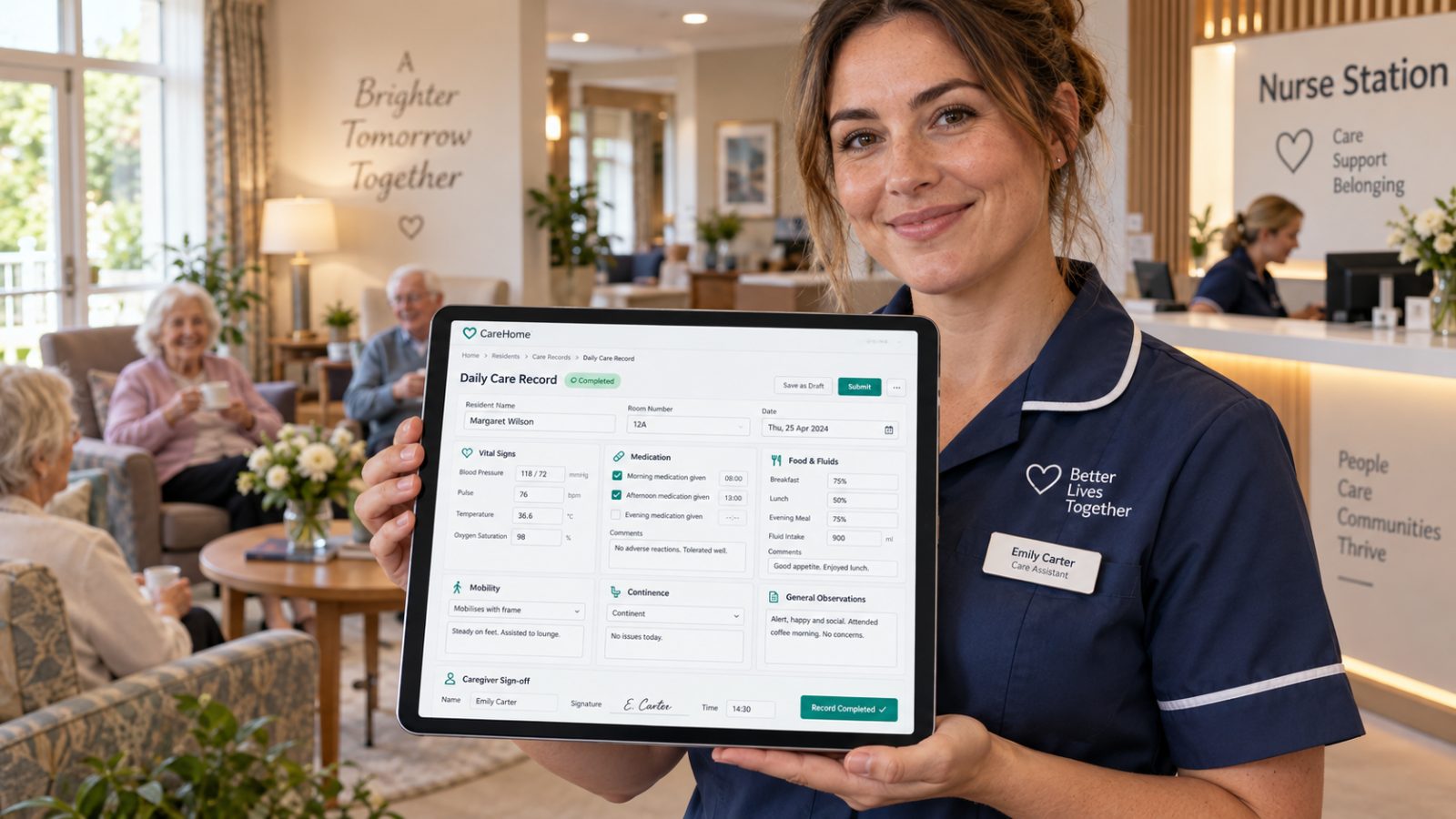
A South African Guide to Governance, Registration and Accountability. Different ownership models. A shared responsibility to protect residents.
Before opening a care home, ask a question that goes beyond buildings and beds: who will govern the organisation, who may benefit financially, and how will decisions be held to account?
A private, for-profit operator and a nonprofit operator can both deliver residential care. Their ownership and financial rules differ, but neither model avoids the applicable care-facility registration process. [2], [4]
This guide focuses on residential care for older persons, including dementia care. It compares a private company with nonprofit arrangements; it is not a complete guide to every healthcare service, housing model or provincial approval.
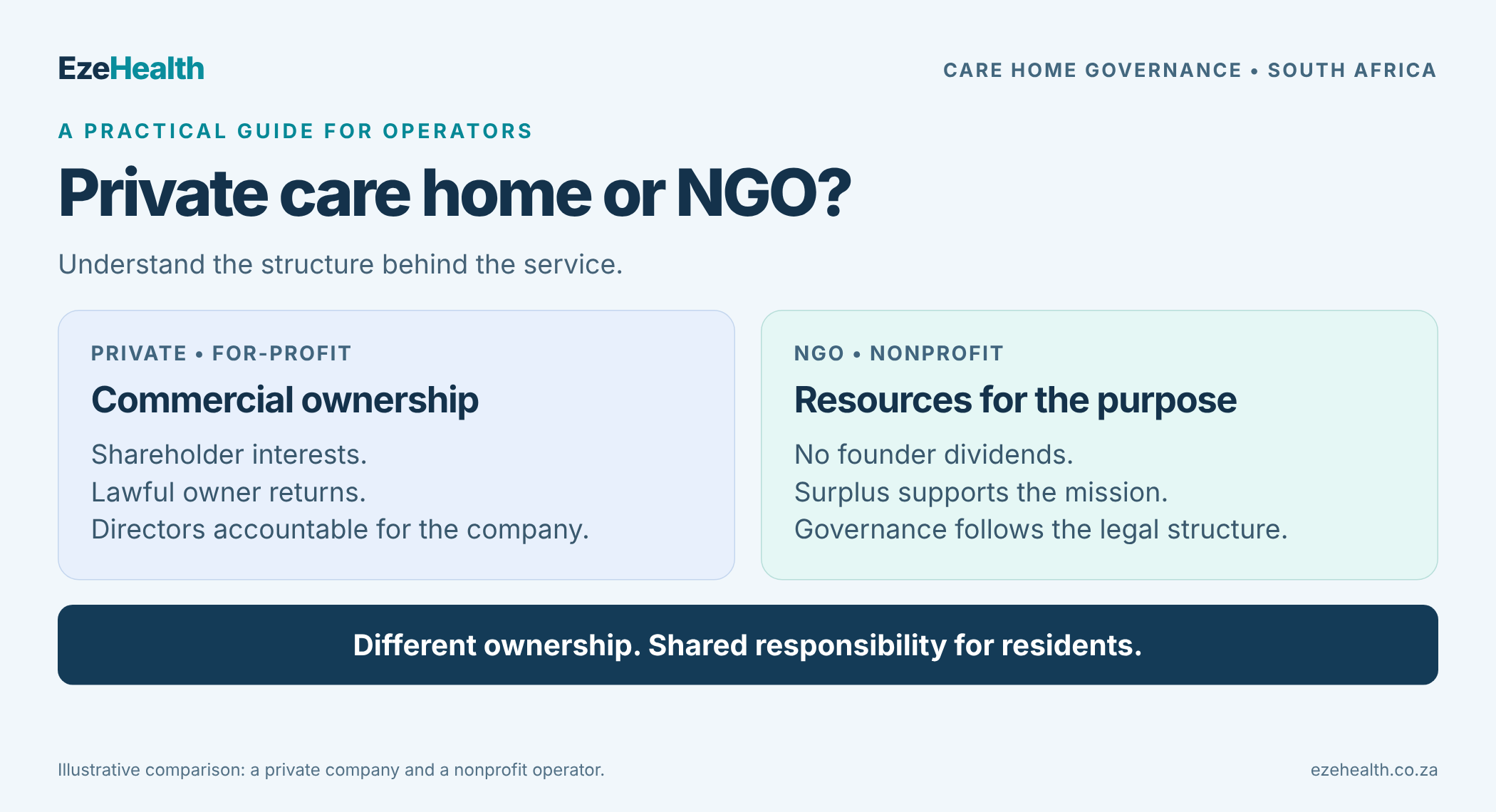
First, “private” and “NGO” are not opposites
An NGO can be privately established and independently operated. “NGO” describes a non-governmental organisation; it is not a single legal form. A nonprofit operation may use a nonprofit company (NPC), a trust or a voluntary association, each with its own governing arrangements. [2], [3]
For clarity, “private care home” here means a for-profit operation. “NGO care home” means a nonprofit operation. Charging fees does not, by itself, turn a nonprofit into a for-profit business: SARS guidance recognises income such as rent and accommodation charges. The purpose, use of funds and applicable tax conditions remain important. [8]
1. Who controls the organisation—and what happens to the surplus?
In a private company, shareholders hold ownership interests and directors govern the company. Lawful distributions are possible, subject to the Companies Act. An NPC must apply its assets and income to its stated objectives rather than treat its surplus as a founder’s dividend. [1], [2]
| Governance question | Private company — (Pty) Ltd | Nonprofit company — NPC |
|---|---|---|
| Ownership | Shareholders hold equity interests. | No equivalent shareholder entitlement to profits. |
| Governing body | Directors, under the Act and MOI. | Directors, under the Act and nonprofit MOI. |
| Baseline director minimum | One; the MOI or other applicable rules may require more. | Three; the MOI or other applicable rules may require more. |
| Surplus | May be retained or lawfully distributed. | Must advance the stated nonprofit objectives. |
| Remuneration | Genuine services may be remunerated. | Reasonable payment for genuine services is permitted. |
| Net assets on closure | Shareholders may receive residual value after liabilities and legal requirements. | Remaining net value goes to qualifying nonprofit recipients, not founders. |
MOI means Memorandum of Incorporation. This company-to-company comparison does not prescribe the governance structure of a trust or voluntary association. [3]
Choose the structure by asking what you are trying to build. Is it an owner-invested business with commercial returns, or an institution whose resources should remain dedicated to its purpose? Make that decision before drafting the governing documents.
2. Do not confuse five different registrations and approvals
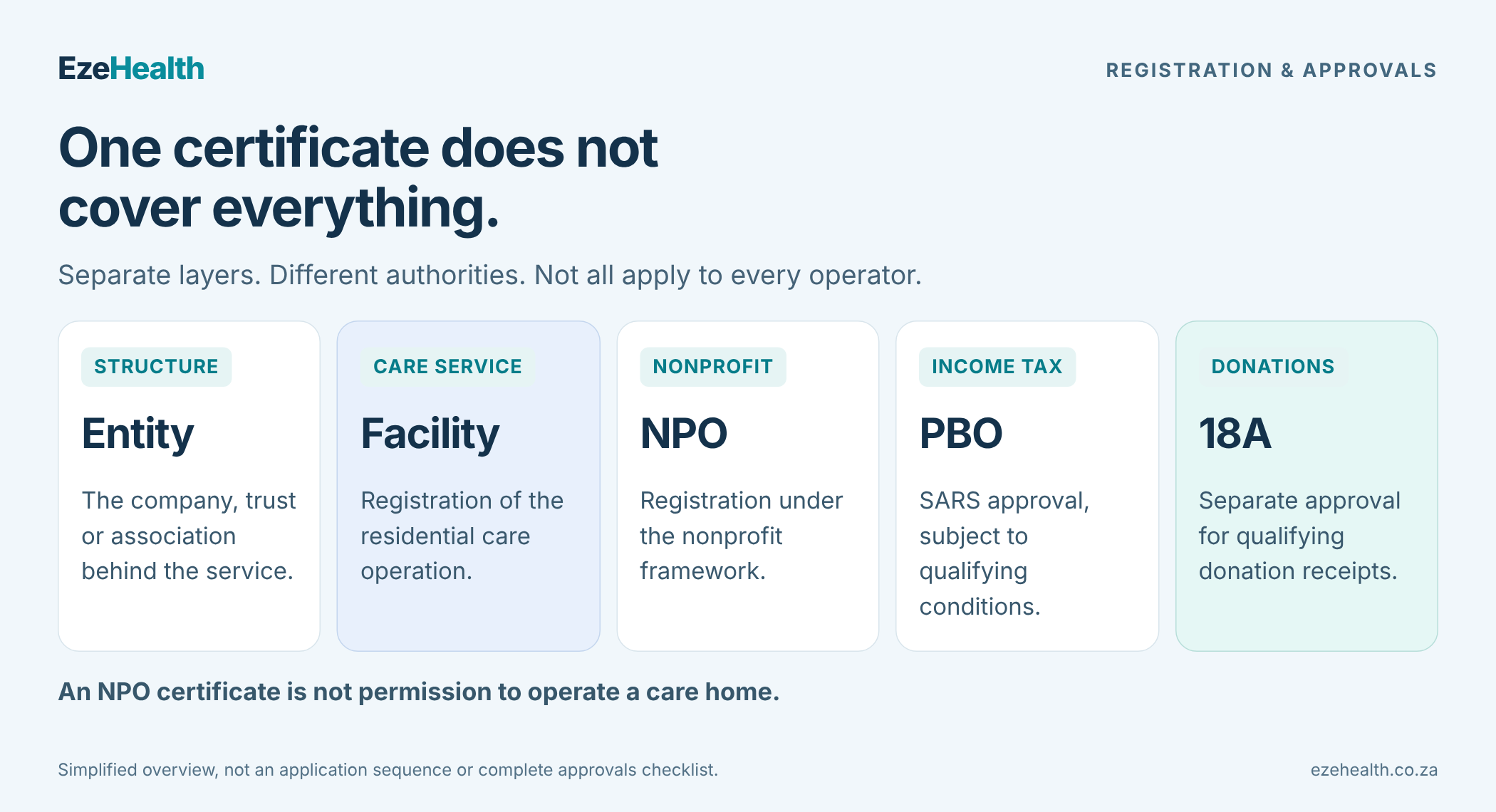
Entity formation establishes the organisation. Care-facility registration addresses the residential operation. Nonprofit organisation (NPO) registration addresses the nonprofit framework. Public benefit organisation (PBO) approval concerns qualifying income-tax treatment. Section 18A approval concerns qualifying tax-deductible donations. [2], [3], [4], [7]
An NPO certificate is not permission to operate a care home. An NPC certificate is not automatic tax exemption. [2], [4], [7]
PBO approval does not automatically authorise section 18A receipts. Certain trading income may still be taxable, and VAT obligations may arise. Equally, ordinary resident fees must not be relabelled as donations to obtain a tax benefit. [7], [8]
For a proposed facility, first describe the intended residents, services and capacity to the relevant provincial Department of Social Development (DSD). Request its current application requirements and identify the additional municipal and health-authority enquiries needed for that service model. [4], [9]
3. Nonprofit does not mean unpaid—or founder-controlled
A nonprofit can employ professional staff and remunerate a founder who performs genuine work. For a PBO, SARS requires remuneration to be reasonable for the services and sector, and consistent with the organisation’s objects. [8]
For PBO approval, SARS generally requires at least three mutually unconnected people to accept fiduciary responsibility and prohibits one person from controlling decision-making directly or indirectly. This is different from merely meeting the NPC’s three-director minimum; specific exceptions and structures require advice. [7], [8]
Our practical recommendation is to document roles, benchmark remuneration and use an approval process that properly handles conflicts. A founder’s salary, a lease of founder-owned premises or a contract with a relative’s business should never be treated as an informal withdrawal of nonprofit funds.
NPO registration also does not guarantee a government subsidy. Funding decisions and contracts have their own conditions, reporting obligations and remedies for non-compliance. [6]
4. A private home may still need a residents’ committee
Section 20 of the Older Persons Act requires a residents’ committee where more than 10 older persons reside in a residential facility, excluding a shelter. The requirement is not limited to NGOs or subsidised facilities. [5]
The regulations provide for five to twelve members, with resident, staff, community and facility-manager representation, and monthly meetings after the initial meeting. Eligibility and election rules must also be followed. [6]
The committee’s statutory work includes oversight of service quality, staff training, complaints, abuse prevention and the manager’s quarterly financial reporting to residents and staff. It is not simply a social-events group. [5]
The company board is not the residents’ committee. One does not automatically replace the other. [1], [5]
For a dementia facility, seek written guidance on lawful, meaningful representation where residents cannot participate fully. Do not assume that an informal family forum satisfies the prescribed arrangements.
5. Financial accountability exists in both models
Registered residential facilities have a section 23 reporting obligation within 60 days after financial year-end, covering service standards, abuse prevention and applicable service-level agreements. [5]
Regulation 4 separately addresses annual reporting with audited financial statements and specifies a 90-day residential-facility timetable. Have the applicable requirements confirmed with DSD and your accountant; a company-law audit exemption alone should not settle the care-sector question. [6]
A registered NPO has an additional annual submission to the NPO Directorate, due within nine months after financial year-end, including narrative and financial reporting. PBOs also have continuing SARS obligations. [3], [7]
Build one reporting calendar, but keep each submission distinct. Record the responsible person, reviewer, due date, required evidence and proof of submission. Different reports should not be treated as interchangeable simply because they use the same financial year.
6. Dementia care adds questions—not an exemption
The Older Persons Act expressly includes care and supervision for older persons with dementia. Nonprofit status does not resolve the separate questions raised by the proposed residents, services or care setting. [5]
Before admitting residents, obtain appropriate advice on consent and lawful representation, supervision, medication processes, emergency escalation and any additional health approvals. Ask the provincial authorities to confirm the route for the actual service you intend to provide.
Western Cape DSD guidance identifies safe and accessible buildings, appropriate nurses and trained carers, admission documentation, evidence of care, policies and safe nutrition as compliance matters. These are useful planning themes—not a substitute for checking the requirements applicable in your province. [9]
7. Turn governance into a working routine
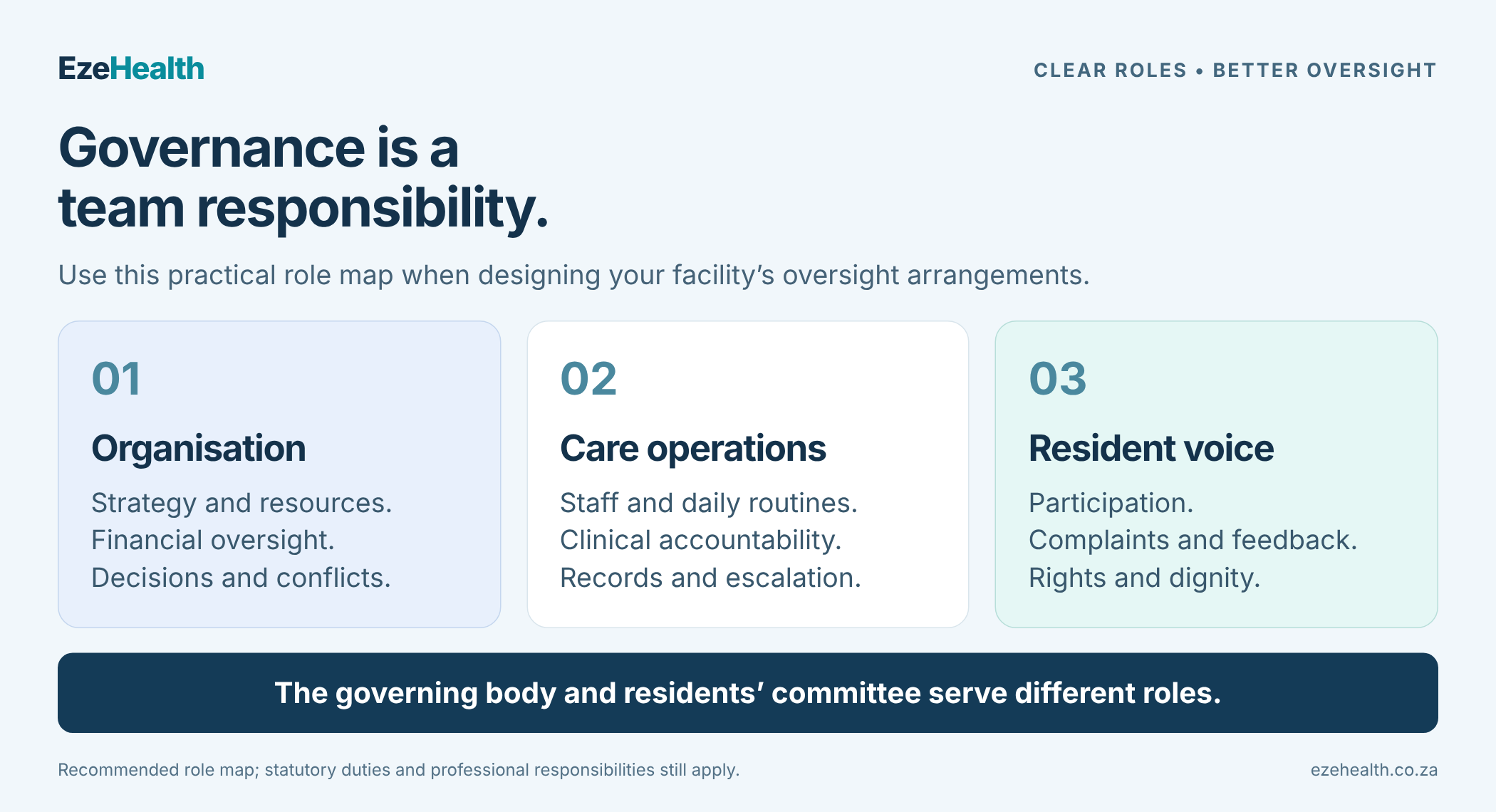
As a practical management approach, separate organisational decisions, daily operations, clinical accountability and resident participation. Define who decides, who implements, who reviews and who must be consulted.
Consider a fictional home reviewing repeated falls. The clinical team assesses individual residents; the manager checks routines and training; the governing body considers resources and unresolved risks; resident-participation processes raise concerns about the living environment. Record the actions without circulating unnecessary personal clinical information; see our POPIA compliance page for how EzeHealth handles resident data.
A useful management pack would bring together cash flow, occupancy, staffing, training, significant incidents, complaints, maintenance, outstanding approvals and overdue actions. Give each action an owner and a due date, then check whether it was completed.
The test is not how many policies sit in a folder. (For the operational side of that argument, read Paperwork is stealing care time.) Ask whether a concern reaches the right person, results in a decision and leads to a recorded follow-up.
How EzeHealth supports the work behind good governance
EzeHealth was developed by EzeMind AI, founded by Johan van Niekerk, in response to needs identified by Johan and Marlene, owners of Jura Care Village in George. Its starting point was practical: make the information and administration behind care easier to manage.
The platform brings together resident information, care plans, medication records, vitals, handovers and incidents, with compliance reporting generated from live records. AVA provides an AI-assisted way for authorised teams to work with facility information in English and Afrikaans. [11]
That gives operators a practical starting point for organising evidence and following up care-related issues. Use it alongside financial, corporate and professional oversight—not as a replacement for them. AI-generated summaries and suggestions should be checked by accountable staff.
Software can support governance. It cannot become the accountable operator, guarantee compliance or replace professional judgement.
Choose the model. Keep the resident at the centre.
Choose your legal structure deliberately, then give it a workable governance system: clear responsibilities, properly handled conflicts, current approvals, reliable records and visible follow-through.
Whether your home is owner-funded or nonprofit, make the same commitment: decisions that can be explained, concerns that are addressed and care that can be evidenced.
Build clearer systems for better care.
Explore how EzeHealth can support your care home’s records, handovers and operational oversight. Book an EzeHealth demonstration.
Book a demonstration See compliance & reporting
Educational information, not legal, tax or clinical advice. Requirements depend on the legal entity, services, residents, funding arrangements and location. Obtain advice from qualified South African professionals and confirm requirements with the relevant authorities before acting.
Sources checked on 11 September 2026. The government page for the Older Persons Amendment Act 1 of 2025 lists commencement as “to be proclaimed”. Recheck commencement and later changes before relying on or republishing this guide. [10]
Frequently asked questions
Is an NGO care home the same as a nonprofit company?
No. "NGO" describes a non-governmental organisation, not a legal form. A nonprofit care home may be a nonprofit company (NPC), a trust or a voluntary association, each with its own governing rules. Charging fees does not by itself make it a for-profit business; the purpose and use of funds, and the tax conditions, are what matter.
Does a private care home need a residents' committee?
Yes, if more than 10 older persons reside there. Section 20 of the Older Persons Act requires a residents' committee in any residential facility above that size, whether private or NGO, with five to twelve members representing residents, staff, the community and the manager, meeting monthly.
Does NPO registration allow us to operate a care home?
No. NPO registration addresses the nonprofit framework only. A residential facility for older persons must still be registered with the provincial Department of Social Development, and an NPC certificate does not give automatic tax exemption; PBO approval and section 18A approval are separate SARS processes.
What reports must a registered care home submit each year?
A section 23 report within 60 days of financial year-end covering service standards, abuse prevention and service-level agreements; annual reporting with audited financial statements under regulation 4; and, for a registered NPO, an annual narrative and financial submission to the NPO Directorate within nine months of year-end. PBOs have continuing SARS obligations as well.
Official sources and further reading
- Companies Act 71 of 2008: sections 46 and 66; Schedule 1
- South African Government: Register a non-profit company
- South African Government: Register a nonprofit organisation
- South African Government: Register an old age home
- Older Persons Act 13 of 2006: sections 17, 18, 20 and 23
- Regulations Regarding Older Persons, 2010: regulations 2–4, 17 and 19
- SARS: Public Benefit Organisations
- SARS: Tax Exemption Guide for Public Benefit Organisations, Issue 7
- Western Cape Government: Older persons programme
- Older Persons Amendment Act 1 of 2025: commencement status
- EzeHealth: platform and AVA overview